Menu






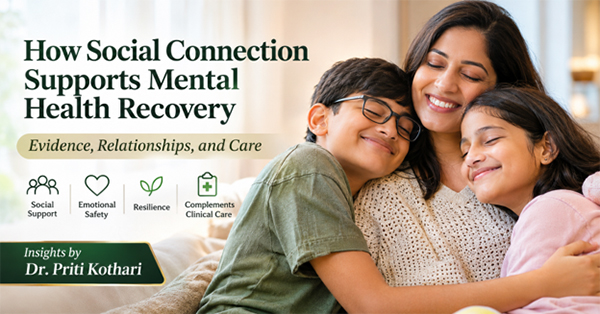
How Social Connection Supports Mental Health Recovery: Evidence, Relationships, and Care
Mental health recovery involves more than managing symptoms. It may also mean rebuilding confidence, restoring routines, and reconnecting with others. Research links social support with better psychological adjustment, making connection an important part of mental health care.
What research tells us
A 2025 study in American Psychologist synthesized 60 meta-analyses, encompassing more than 2,700 studies and 2.1 million participants. It found a consistent association between social support and psychological adjustment, including depression, post-traumatic stress, and stress. Perceived support, believing help is available when needed, showed a stronger association than support received.
Peer-support evidence is promising but nuanced. A systematic review of 30 randomized controlled trials involving 4,152 participants found small improvements in clinical and personal recovery. It did not establish an improvement in functional recovery, and researchers cautioned that study quality was modest. Connection can help, but it is not a stand-alone treatment or a guaranteed outcome.
What meaningful support looks like
Effective support is not measured by the size of someone’s social circle. It is found in relationships where people feel heard, respected, and safe. It may involve listening without judgment, helping with tasks, attending an appointment together, or checking in consistently.
For children and adolescents, dependable caregivers and adults can offer reassurance, structure, and opportunities to discuss difficult emotions. Adults may find support through family, friends, partners, peer groups, or people with shared experiences. Needs differ; support should respect personal preferences, culture, and boundaries.
How families can help
Ask what would be useful instead of assuming. Listen before advising, avoid minimizing distress, and encourage professional assessment when emotional or behavioral changes persist or disrupt daily life. If someone faces immediate danger, seek emergency or crisis assistance.
Connection complements clinical care
Dr. Priti Kothari’s approach recognizes that mental health is shaped by biological, psychological, developmental, and social factors. Emotional support systems do not replace professional assessment, evidence-based therapy, or medication when appropriate. They can help people feel less alone while navigating care.
The message behind The Role of Emotional Support Systems in Mental Health Recovery: Why Connection Matters is clear: supportive relationships are not a cure, but they can be a part of recovery.

Dr.Kothari is amazing! She has been my doctor for years...
I have been a patient of Dr. Kothari for over three years. She has invested her heart...
Dr. Kothari has been seeing my sons for seven years. She is a wonderful resource...
Dr. Kothari is very caring. Appointments and waiting times are great...
When we started seeing Dr. Kothari, my son was dealing with a great...
Dr. Kothari has saved my life, this I can say without reservation...
 Patient Forms
 Videos
 Location