Menu
Menu





Can Your Voice Reveal What Your Teenager Cannot Say?
Depression in adolescence does not always announce itself through obvious sadness. Sometimes, the signs are quieter a change in how a teenager speaks, responds, interacts, or expresses themselves. But what if technology could help us notice those changes before they become impossible to ignore?
Emerging research is exploring whether speech patterns can provide clues about depression risk in young people. A recent study investigated Speech-Based Machine learning models that analyze acoustic features of speech to identify adolescents who may be at increased risk for depressive symptoms. The findings point toward an intriguing possibility: the voice itself may contain information that traditional screening methods do not always capture.
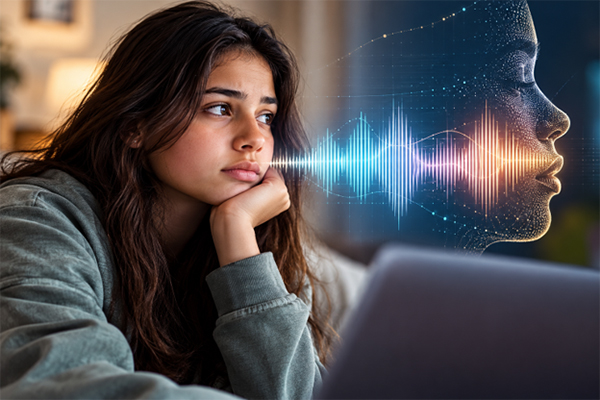
When Depression Hides in Plain Sight
Teenagers do not always have the words or the willingness to explain what they are experiencing. Depression may appear as withdrawal, irritability, declining motivation, disrupted routines, or subtle changes in communication.
That makes early recognition particularly important.
For a psychiatrist such as Dr. Priti Kothari, understanding an adolescent means looking beyond a single symptom. Her work in child and adolescent psychiatry emphasizes comprehensive evaluation and consideration of biological, psychological, social, behavioral, and environmental factors.
Technology may eventually add another layer to that understanding.
Could Technology Listen Before We Notice?
A Speech-Based Machine approach could potentially become another tool for identifying patterns that deserve closer attention. Importantly, it should not be viewed as a diagnosis. Voice analysis cannot replace a thoughtful conversation, clinical evaluation, or the human relationship at the center of psychiatric care.
Instead, the future may involve technology helping clinicians ask better questions sooner.
For parents, this raises a provocative question: What if the earliest warning sign of depression isn’t what a teenager says – but how they say it?
As research evolves, the intersection of artificial intelligence and adolescent psychiatry could open new possibilities for earlier awareness, more personalized assessment, and ultimately, more responsive mental health care.

Dr.Kothari is amazing! She has been my doctor for years...
I have been a patient of Dr. Kothari for over three years. She has invested her heart...
Dr. Kothari has been seeing my sons for seven years. She is a wonderful resource...
Dr. Kothari is very caring. Appointments and waiting times are great...
When we started seeing Dr. Kothari, my son was dealing with a great...
Dr. Kothari has saved my life, this I can say without reservation...
 Patient Forms
 Videos
 Location