Menu
Menu





The Rise of School Shootings in the USA: Causes, Impact, and the Path Forward
By Dr. Priti Kothari – Child, Adolescent & Adult Psychiatry
Introduction
School shootings in the United States have shifted from rare tragedies to a recurring national crisis. These violent incidents leave long-lasting emotional, educational, and social consequences for children, families, and entire communities. As a psychiatrist working with young people and adults, I see firsthand how trauma, fear, and uncertainty affect mental health and development.
This blog explores why school shootings are rising, what the data shows, how they impact students today, and what strategies can help schools and families create safer environments.
- The Scope of the Problem: School Gun Violence in Numbers
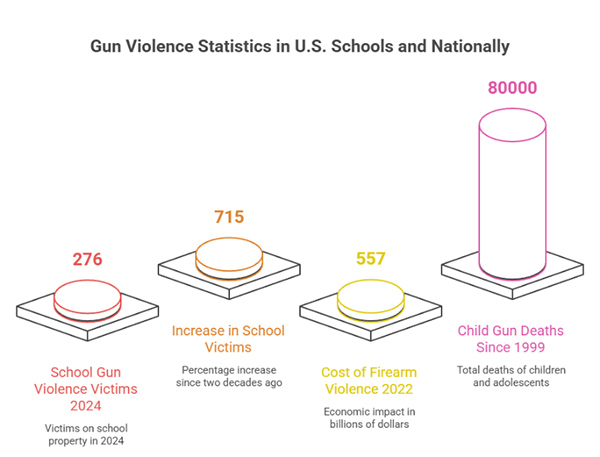
In 2024 alone, there were 276 victims of gun violence on school property, marking a 715% increase compared to two decades earlier.
2024 also recorded the second-highest number of K–12 school shooting incidents, falling just slightly below the all-time peak recorded in 2023.
Beyond schools, the broader picture is even more concerning: firearm violence in the U.S. cost an estimated $557 billion in 2022, including medical, mental-health, and productivity losses.
A 2025 federal analysis revealed that since 1999, more than 80,000 American children and adolescents have died from gun-related injuries.
These numbers highlight a crisis that is not only about weapons—but also about the well-being and safety of America’s youth.
- Why Are School Shootings Increasing?
a) Readily Available Firearms
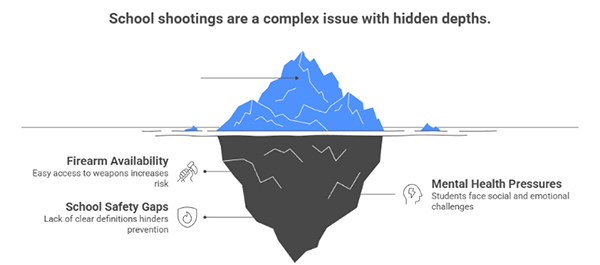
Among all high-income nations, the U.S. stands alone: firearm homicide rates are 25 times higher, and firearm suicide rates nearly 10 times higher than peer countries.
Easy access increases the probability that conflicts, emotional crises, or ideation escalate into deadly violence.
b) Social, Emotional & Mental Health Pressures
Today’s students face unprecedented pressures:
- Social media exposure and cyberbullying
- Loneliness and social isolation
- Untreated mental-health conditions
- Family stress or instability
When these pressures intersect with access to firearms, the risk multiplies.
c) School Safety Gaps
In 2024, many school-based gun incidents were directly tied to student disputes that escalated.
A major challenge is that “school shooting” has no universal definition, making it harder to track patterns or build consistent, effective interventions.
- The Impact on Students, Families, and Communities

Emotional & Psychological Effects
Children exposed to school shootings—whether directly or indirectly—face increased risks of:
- PTSD
- Anxiety and panic symptoms
- Depression
- Sleep disturbances
- Difficulty concentrating
- Hypervigilance
Studies show these effects can persist into adulthood.
Educational Consequences
Long-term research shows that students in schools affected by shootings experience:
- Drops in academic performance
- Lower graduation rates
- Reduced likelihood of enrolling in college
Trauma affects learning, cognition, attendance, and motivation.
School Staff and Parents
A nationwide survey in 2024 found that a majority of U.S. teachers are worried about school shootings, with nearly 1 in 5 being “very or extremely worried.”
Parents report similar anxieties, often feeling uncertain about their children’s safety at school.
Financial and Community Burden
Gun violence costs society hundreds of billions annually—not just in medical care, but also in mental-health needs, school security upgrades, and long-term economic loss.
- Strategies That Make Schools Safer
a) Threat Assessment & Early Intervention
More schools are adopting models like the Comprehensive School Threat Assessment Guidelines (CSTAG), which emphasize:
- Early identification of concerning behaviors
- Mental-health evaluations
- Collaborative intervention plans
- Avoiding zero-tolerance approaches that may worsen outcomes
b) Improved Security With Humanity in Mind
Effective school safety is not only about security tech—it’s also about:
- Strong student-adult relationships
- On-site mental-health support
- Trauma-informed staff training
- Systems that encourage students to report concerns safely
c) Prioritizing Mental Health
Children need spaces to express emotions, process stress, and feel connected.
Schools with robust mental-health programs see lower rates of violence and higher levels of student engagement.
d) Community Partnership
Family involvement and community resources play a crucial role in preventing school violence. Students who feel seen, connected, and supported are far less likely to engage in harmful behavior.
- What Parents Can Do
Recognize Warning Signs
While most youth will never engage in violence, certain warning signs—sudden isolation, obsession with weapons, drastic behavior changes—should prompt professional evaluation.
Build Open Communication
Regular conversations about school life, friendships, online experiences, and emotional health help children feel safer and more supported.
Engage With the School
Ask about:
- Safety protocols
- Mental-health supports
- Threat-assessment programs
- Emergency communication systems
Support Your Child’s Emotional Health
Encourage healthy routines, balanced screen use, friendships, physical activity, and professional support when needed.
Conclusion & Call to Action
School shootings represent one of the most painful threats facing American children—but understanding the root causes and emphasizing mental health, prevention, and community partnership can build a safer path forward.
If you’re a parent, caregiver, or educator concerned about your child’s emotional well-being or the impact of school violence, you don’t have to navigate this alone.
Dr. Priti Kothari’s practice offers trauma-informed care, resilience-building support, and family-centered psychiatric services.
👉 Schedule a consultation today at:
www.drpritikothari.com
Together, we can help children feel safer, stronger, and more supported in an uncertain world.
References
(Each reference listed once, covering all statistics used.)
- School Shootings 2024: Gun Violence on School Property– Omnilert (2024).
https://www.omnilert.com/blog/school-shootings-2024 - School Shootings in 2024 Near Record High– K-12 Dive (2025). https://www.k12dive.com/news/school-shootings-2024-near-record-high-2025-predictions/736590
- Health & Economic Costs of Gun Violence (2022)– Commonwealth Fund (2024).
https://www.commonwealthfund.org - Cumulative Costs of Gun Violence on Students and Schools– White House CEA (Jan 15, 2025).
https://bidenwhitehouse.archives.gov/cea/written-materials/2025/01/15/the-cumulative-costs-of-gun-violence-on-students-and-schools - Gun Violence in the United States– Johns Hopkins Center for Gun Violence Solutions.
https://publichealth.jhu.edu - Teacher Concerns About School Safety– Reuters (2024).
https://www.reuters.com/world/us/most-us-teachers-worry-about-school-shootings-survey-finds-2024-04-12 - Long-Term Educational Impact of School Shootings– Stanford SIEPR (Study).
https://siepr.stanford.edu

Dr.Kothari is amazing! She has been my doctor for years...
I have been a patient of Dr. Kothari for over three years. She has invested her heart...
Dr. Kothari has been seeing my sons for seven years. She is a wonderful resource...
Dr. Kothari is very caring. Appointments and waiting times are great...
When we started seeing Dr. Kothari, my son was dealing with a great...
Dr. Kothari has saved my life, this I can say without reservation...
 Patient Forms
 Videos
 Location