Menu






Why Do Some Tasks Feel More Effortful for People With ADHD?
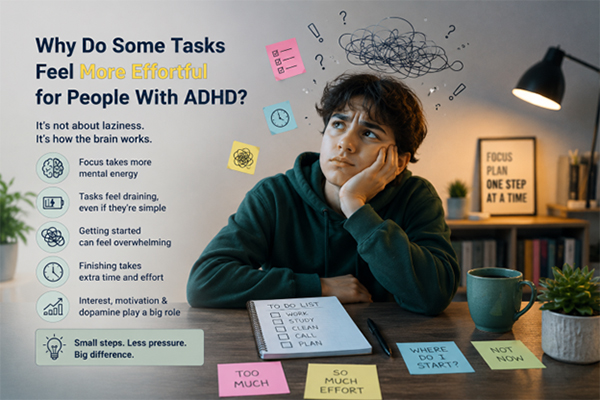
Some tasks feel easy to start and complete, while others feel unusually difficult, even when they are simple. For individuals with ADHD, this difference can be more noticeable. Tasks that seem straightforward to others may require more mental effort, time, and energy.
If you or your child often feel drained by routine tasks or struggle to get through activities that should feel manageable, it may be related to how ADHD affects effort, attention, and motivation.
What Does “Effortful” Mean in ADHD?
In ADHD, effort is not only about physical or mental work. It is also about how the brain activates and sustains attention. Tasks that require focus, organization, or repetition may feel more demanding because they require continuous mental regulation.
This does not reflect a lack of ability. It reflects how the brain processes and maintains effort.
Common Signs That Tasks Feel More Effortful
1. Mental Fatigue
Feeling tired quickly, even during simple tasks.
2. Difficulty Getting Started
Tasks feel heavy or hard to begin.
3. Losing Focus Easily
Effort increases when attention keeps shifting.
4. Avoiding Certain Tasks
Especially those that feel repetitive or uninteresting.
5. Slower Task Completion
Tasks take longer due to increased effort.
6. Feeling Overwhelmed
Tasks may feel bigger or more complex than they are.
7. Inconsistent Energy Levels
Some tasks feel easy, while others feel exhausting.
Why Tasks Feel More Effortful in ADHD
Several underlying factors contribute to this experience:
- Attention Regulation Differences
Sustaining focus requires more effort. - Executive Functioning Challenges
Planning, organizing, and completing tasks takes extra mental energy. - Dopamine Differences
Lower reward sensitivity makes tasks feel less engaging. - Task Interest Levels
Less interesting tasks feel more effortful to complete. - Working Memory Limitations
Holding and processing information increases mental load. - Cognitive Fatigue
The brain tires more quickly when maintaining focus.
How This Affects Daily Life
Increased effort can impact:
- Productivity at school or work
- Ability to complete daily tasks
- Energy levels throughout the day
- Motivation and consistency
- Confidence and self-esteem
Over time, individuals may feel exhausted or frustrated, especially when effort does not match outcomes.
When to Seek Help From an ADHD Specialist
Consider a professional evaluation if:
- Tasks consistently feel more effortful than expected
- You feel mentally drained by routine activities
- Focus requires constant effort
- Daily functioning is affected
An ADHD specialist can assess whether these challenges are related to ADHD and recommend appropriate support.
Strategies and Treatment Options to Reduce Mental Effort
Support often includes a combination of practical strategies and professional care:
- Breaking Tasks Into Smaller Steps
Reduces mental load and increases clarity. - Using Structured Routines
Makes tasks more predictable and less effortful. - Taking Regular Breaks
Prevents mental fatigue. - Reducing Distractions
Helps conserve mental energy. - Using External Supports
Checklists, reminders, and tools reduce effort. - Behavioral Therapy or Coaching
Builds strategies to manage effort and focus. - Medication When Appropriate
May improve attention and reduce cognitive strain.
With the right strategies, tasks can feel more manageable and less draining.
About Dr. Priti Kothari
Dr. Priti Kothari is a board-certified child, adolescent, and adult psychiatrist providing comprehensive mental health care in Boca Raton. She specializes in ADHD, anxiety, depression, and stress-related conditions, offering comprehensive evaluations and personalized treatment plans for children, teens, and adults, including challenges such as mental fatigue, task effort, and attention regulation.
Dr. Kothari helps individuals develop practical strategies to manage effort, improve focus, and reduce daily overwhelm.
Frequently Asked Questions
Why do simple tasks feel harder with ADHD?
Because sustaining attention and effort requires more mental energy.
Is this due to lack of motivation?
No, it reflects how the brain processes effort and attention.
Can children and adults both experience this?
Yes, this challenge can affect individuals at any age.
Can tasks feel easier with strategies?
Yes, structured approaches can reduce effort and improve efficiency.
Does treatment help reduce mental fatigue?
Many individuals benefit from therapy, strategies, and sometimes medication.
References
- Faraone, S. V., Biederman, J., & Mick, E. (2006). The Age-Dependent Decline of ADHD Symptoms
https://pubmed.ncbi.nlm.nih.gov/16832325/ - Volkow, N. D., Wang, G. J., Kollins, S. H., et al. (2009). Evaluating Dopamine Reward Pathway in ADHD
https://jamanetwork.com/journals/jama/fullarticle/183444 - Sonuga-Barke, E. J. S. (2005). Causal Models of ADHD: From Common Simple Deficits to Multiple Developmental Pathways
https://pubmed.ncbi.nlm.nih.gov/15950015/ - Halperin, J. M., & Schulz, K. P. (2006). Revisiting the Role of the Prefrontal Cortex in ADHD
https://pubmed.ncbi.nlm.nih.gov/16904669/

Dr.Kothari is amazing! She has been my doctor for years...
I have been a patient of Dr. Kothari for over three years. She has invested her heart...
Dr. Kothari has been seeing my sons for seven years. She is a wonderful resource...
Dr. Kothari is very caring. Appointments and waiting times are great...
When we started seeing Dr. Kothari, my son was dealing with a great...
Dr. Kothari has saved my life, this I can say without reservation...
 Patient Forms
 Videos
 Location